Blog
Why H13 cracks after heat treatment?

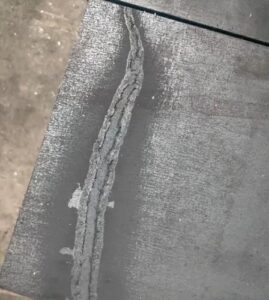
Why does H13 crack after heat treatment?
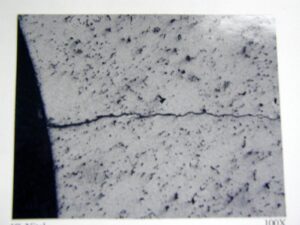
Heat Treatment of H13 Tool Steel can lead to cracking mainly because of thermal stress, improper process control, and microstructural transformation stress.
Main Reasons
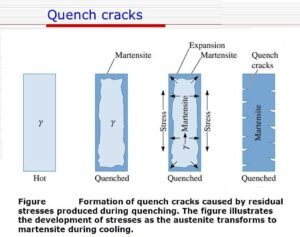
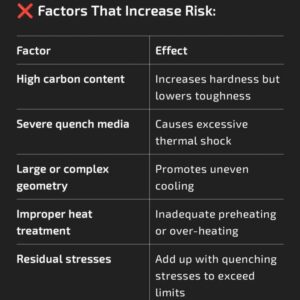
1. Excessive Quenching Stress
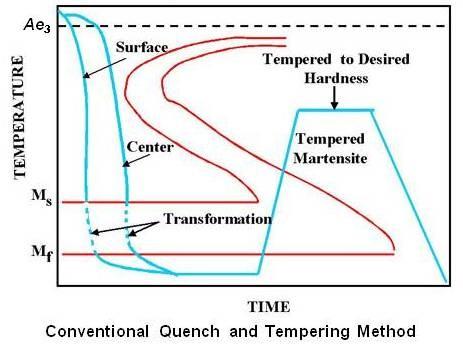
- Cooling too fast creates large temperature differences between surface and core.
- Surface contracts first while the core is still hot → internal tensile stress forms.
- If stress exceeds H13 toughness → cracks appear.
2. Incorrect Austenitizing Temperature
H13 is usually hardened at 1020–1050°C
If overheated:
- Grain growth occurs
- Toughness drops
- Steel becomes brittle and crack-sensitive
If underheated:
- Incomplete carbide dissolution
- Uneven hardness distribution
- Localized stress concentration
3. Insufficient Preheating
Directly heating cold H13 to hardening temperature causes thermal shock.
Recommended:
- First stage: 550–650°C
- Second stage: 850–900°C
- Then final hardening temperature
This reduces thermal gradient stress.
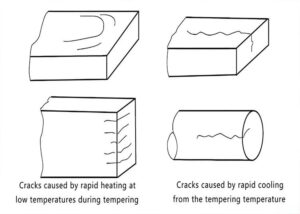
4. Improper Tempering
H13 requires double or triple tempering
If tempering is insufficient:
- Residual martensitic stress remains
- Retained austenite transforms later
- Delayed cracking occurs
Typical tempering:
540–620°C × 2–3 cycles
5. Material Defects
Internal issues like:
- Segregation
- Non-metallic inclusions
- Forging cracks
- Decarburized layer
These become crack initiation points during quenching.
6. Poor Part Geometry
Sharp corners / uneven wall thickness create stress concentration.
Crack Formation Process
σthermal=EαΔT\sigma_{thermal}=E\alpha\Delta T
Where:
- σ = thermal stress
- E = elastic modulus
- α = thermal expansion coefficient
- ΔT = temperature difference
Large ΔT = large stress = cracking risk.
How to Prevent H13 Cracking
✅ Multi-stage preheating
✅ Control hardening temp (1020–1050°C)
✅ Uniform cooling / proper quench medium
✅ Triple tempering
✅ Avoid overheating
✅ Use ESR / high-cleanliness H13
✅ Add corner radii to molds
✅ Stress-relief after machining
For mold steel production, most H13 cracking comes from overheating + fast quenching + poor tempering control.