

Blog
D2 vs SKD11: What’s the Difference?

Many people assume D2 and SKD11 are exactly the same, but they are very similar rather than identical.
- D2 is the American AISI standard
- SKD11 is the Japanese JIS standard
Both are high-carbon, high-chromium cold-work tool steels widely used for dies, punches, blades, and wear-resistant tooling.
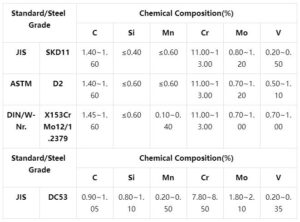
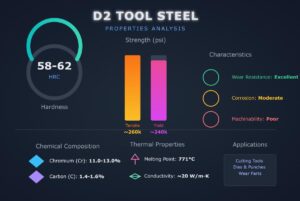
| Property | D2 | SKD11 |
|---|---|---|
| Standard | AISI (USA) | JIS (Japan) |
| Carbon | 1.40–1.60% | 1.40–1.60% |
| Chromium | 11–13% | 11–13% |
| Hardness (HRC) | 58–62 | 58–62 |
| Wear Resistance | Excellent | Excellent |
| Toughness | Medium | Slightly better consistency |
| Distortion Resistance | Good | Very good |
| Cost | Usually lower | Usually slightly higher |
1. Chemical Composition
Typical composition:
D2
- Carbon: 1.50%
- Chromium: 12.0%
- Molybdenum: 0.8%
- Vanadium: 0.9%
SKD11
- Carbon: 1.45–1.55%
- Chromium: 11–13%
- Molybdenum: 0.8–1.2%
- Vanadium: 0.2–0.5%
SKD11 often has tighter process control, especially from premium Japanese and Asian mills.
This results in:
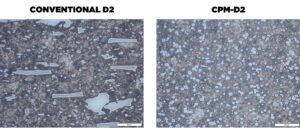
- Better carbide uniformity
- More stable heat treatment performance
- Lower distortion risk
2. Wear Resistance
Both offer excellent wear resistance due to high chromium carbide content.
D2 may show slightly stronger abrasive wear resistance because of larger carbide structures.
Best applications:
- Blanking dies
- Punches
- Shear blades
- Cold forming tools
3. Toughness
SKD11 often performs slightly better in toughness due to:
- Cleaner steelmaking
- More uniform carbide distribution
- Better dimensional stability after heat treatment
This makes SKD11 preferred for:
- Precision dies
- Fine blanking tools
- High-accuracy mold components
4. Heat Treatment Stability
Typical hardening temperature:
1020–1040°C
Tempering:
180–550°C depending on required hardness
Premium SKD11 grades usually show:
- Less distortion
- More predictable hardness response
- Lower cracking tendency
5. Which One Should You Choose?
Choose D2 if:
✔ Cost efficiency matters
✔ Standard industrial tooling
✔ High wear resistance is the priority
Choose SKD11 if:
✔ Precision tooling is required
✔ Better dimensional stability is critical
✔ Customers prefer Japanese-grade certification
✔ Lower distortion risk is important
Final Conclusion
Technically, D2 and SKD11 are highly comparable and interchangeable in most applications.
The main difference is usually manufacturing consistency and market preference:
- D2 → More economical, globally common
- SKD11 → Better consistency, premium positioning, preferred in Asian precision tooling markets
In practical terms:
If quality is controlled well, both can deliver excellent performance.
The better choice often depends more on supplier quality than on the steel designation itself.


